


If you’re shopping for a dependable, fuel-sipping compact in northern New Jersey, two names rise to the top of almost every list: the Honda Civic and the Toyota Corolla. Both have spent decades earning a reputation for starting every morning, running past 200,000 miles, and asking for very little in return. Finding a reliable used Honda Civic or Corolla means looking past the badge and focusing on how the car handles local conditions.
So when buyers walk onto our Route 46 lots, the question we hear most often is simple: should you get a used Honda Civic or a used Toyota Corolla?
Here’s the honest answer up front, then we’ll back it up with data.
Quick Answer
Choose a used Honda Civic if you want a sharper-driving, roomier compact with a modern tech layout and you do not mind paying a slight price premium.
Choose a used Toyota Corolla if your primary goals are the lowest possible running costs, dead-simple engine mechanics, and class-leading highway fuel economy especially in Hybrid form.
Either way, you’re buying one of the best used compact cars on the road. The smartest move is to compare a specific Civic and a specific Corolla in person, on the same day, and let condition and service history make the final call.
Honda Civic vs. Toyota Corolla: Full Comparison Table
| Category | Honda Civic | Toyota Corolla |
|---|---|---|
| Engine Options | 1.5L Turbocharged (most trims) or 2.0L Naturally Aspirated | 1.8L or 2.0L Naturally Aspirated |
| Engine Output & Performance | 158 hp (2.0L base) to 180 hp (1.5L Turbo); snappy 0–60 mph times (~7.2–8.2 seconds) | 132–139 hp (Older 1.8L base) to 169 hp (2.0L dynamic force); relaxed, linear acceleration |
| Highway MPG (Gas, 2018–2023) | Roughly 37–42 MPG depending on trim and year | Roughly 35–41 MPG depending on trim and year |
| Hybrid Availability (2018–2023) | Civic Hybrid arrived in the US as a 2025 model (none for these years) | Corolla Hybrid: 47–52 MPG combined (varies by year) |
| Expected Lifespan | Commonly exceeds 200,000 miles with strict maintenance | Commonly exceeds 200,000 miles with basic maintenance |
| Avg. Annual Repair Cost | ~$368/year (RepairPal data) | ~$362/year (RepairPal data) |
| Available Body Styles | Sedan, Hatchback, Si (Sport Sedan), Type R (Performance) | Sedan, Hatchback (select years), Hybrid Sedan |
| Driver-Assist Suite | Honda Sensing standard on all Civic trims from 2019 onward | Toyota Safety Sense standard on all Corolla trims from 2018 onward |
| Resale Value | Strong; Si/Type R trims hold especially well | Strong; low ownership cost supports resale metrics |
| Rear Seat Legroom | ~37.4 inches (Notably roomier for adults) | ~34.8 inches (Tighter fit for taller passengers) |
The Real Differentiator
The real differentiator when shopping for a used vehicle is not the badge. It is the maintenance history of the specific car in front of you. A well-documented Civic or Corolla under 100,000 miles beats a clean-looking car with a paper-thin service record every single time.

Is a Used Honda Civic or Toyota Corolla More Reliable?
Used Compact Car Reliability Defined
A used compact car is considered reliable when it consistently starts, runs, and completes trips without unplanned repairs across a documented ownership history. Both the Honda Civic and Toyota Corolla meet this standard, with owner-reported lifespans regularly exceeding 200,000 miles when maintained on schedule.
Both the Honda Civic and Toyota Corolla are exceptionally reliable and routinely reach 200,000 miles or more with regular maintenance. Well-kept examples of either model commonly approach the 300,000-mile mark. This is usually the first thing NJ buyers ask about, and it’s the category where the two cars sit closest together.
Spend ten minutes in any owner forum and the same line comes up again and again: you really can’t go wrong with either one.
That said, two honest cautions come up repeatedly from long-term owners regarding the 2018–2023 model years.
Turbocharged Civic Engines
Many newer Civics use a 1.5-liter turbocharged engine. It is strong and highly fuel-efficient, but a turbocharger introduces an extra mechanical system to maintain. Buyers should favor a car with a documented oil-change history over one with a thin paper trail. Turbo engines are significantly more sensitive to skipped oil intervals than naturally aspirated ones because oil cools the turbo bearings.
CVT Automatics in Both Models
Most recent Civics and Corollas use a Continuously Variable Transmission (CVT). Both manufacturers have refined their CVT execution considerably across the 2018–2023 generations. For 2019+ models, Toyota introduced a physical “Launch Gear” to its CVT on 2.0L models. This unique mechanical feature handles the initial acceleration off the line before handing off to the steel belt system, which reduces that common “rubber-band” feeling off the line and lowers long-term wear. Either way, regular fluid changes are the single best indicator of CVT health.
Insider tip: When inspecting any used Civic or Corolla, ask for the CVT fluid change records specifically. Most manufacturer service intervals suggest CVT fluid changes every 30,000–45,000 miles under severe conditions (which NJ stop-and-go traffic qualifies as). A car missing this record is not an automatic disqualifier, but it is a negotiating point and a cost to factor in at purchase.
The lesson from owners is consistent: buy on condition, not reputation. A neglected car is a neglected car regardless of the badge. That’s exactly why every vehicle we list at Carz4Us comes with a free CARFAX report, so you can see the full service and ownership history before you ever take a test drive.
What Owners Are Saying: Real-Reviews from Civic and Corolla Drivers
Numbers tell part of the story, but real-world owner experiences highlight what these compacts feel like over years of daily commuting.
Feedback On the Honda Civic
Low Maintenance Visuals: High-mileage Civic owners on Edmunds regularly describe the car as one of the lowest-maintenance vehicles they have owned, with the main expenses being routine items like brake pads, battery replacements, and tires well past 150,000 miles.
The Turbo Realism: One long-time owner summed up the turbo caution that comes up constantly in forums: the 1.5T engine rewards disciplined oil changes and punishes owners who skip them. Keep up with maintenance and it runs without issue; neglect it and you will notice performance drops.
Cabin Space Dominance: In head-to-head road tests, reviewers noted the Civic still wins for rear-seat space and a more involving drive layout, even after the Corolla’s interior redesign brought significant upgrades.
Feedback On the Toyota Corolla
Zero-Drama Commuting: Corolla owners who put heavy miles on their cars, particularly those commuting daily, consistently describe the experience as one they never have to think about. RepairPal’s owner data backs this up: the Corolla ranks first out of 36 compact cars for reliability, with most owners reporting nothing beyond scheduled maintenance for years at a stretch.
The Hybrid Advantage: The Corolla Hybrid comes up repeatedly among NJ commuters specifically. The recurring theme: fuel savings on the Parkway and Turnpike are real and add up fast, and insurance costs for the Hybrid run lower than expected.
Low Cost Efficiency: Automotive journals still give the Corolla its due as the ultimate no-drama ownership pick, particularly for buyers who want the lowest possible running costs.
Which Has Better Fuel Economy?
Gas-powered Civics and Corollas from the 2018–2023 model years are both efficient. Fuel economy alone shouldn’t decide your purchase.
The Civic’s highway MPG varies by trim. EX trims reach up to 42 MPG highway. LX and Sport trims come in around 37–40 MPG. The Touring trim is closer to 38 MPG highway, per EPA fuel economy estimates.
The Corolla tracks a very similar band. The 2023 LE hits 41 MPG highway. SE and XSE trims land around 40 MPG. Older 2018–2021 models range from 35–38 MPG highway depending on trim and transmission layout.
The real efficiency story for NJ commuters is the Toyota Corolla Hybrid. The 2020–2022 Corolla Hybrid returns 52 MPG combined (EPA-rated). The updated 2023 model returned 47 MPG combined FWD, a slight drop due to larger alloy wheels and increased output, but still outstanding for a used compact sedan.
According to the U.S. Department of Energy’s 2026 fuel cost data, a driver covering 15,000 miles per year in a Corolla Hybrid pays roughly $550–$600 less annually in fuel than in a comparable non-hybrid compact sedan at current national average gas prices. For a five-year hold, that is $2,750–$3,000 in fuel savings.
Repair Costs and Used Total Cost of Ownership
Repair statistics show that annual repair costs for both models sit well below the automotive segment average. Data aggregated by RepairPal from verified repair shops across the US breaks down as follows:
Honda Civic Maintenance: Approximately $368/year in average annual repair costs. The Civic consistently ranks among the top 10 most affordable compact cars to maintain over a ten-year cycle.
Toyota Corolla Maintenance: Approximately $362/year in average annual repair costs. This slightly lower figure matches the Corolla’s historic reputation for total mechanical simplicity.
Estimated 5-Year Total Cost of Ownership Comparison
| Cost Factor | Honda Civic | Toyota Corolla |
|---|---|---|
| Average purchase price (used, 2018–2023) | $17,000–$23,000 | $16,500–$22,000 |
| Avg. annual repair cost | ~$368 | ~$362 |
| Average insurance (NJ, per year) | ~$1,450–$1,700 | ~$1,400–$1,650 |
| Fuel cost (15,000 mi/yr at $3.50/gal) | ~$1,450 (39 MPG avg) | ~$1,460 (38.5 MPG avg) |
| Estimated 5-year total cost | ~$30,800–$37,000 | ~$29,900–$35,900 |
The bottom line: The Corolla is marginally cheaper to run, but the difference over five years is a few hundred dollars, not thousands.
Driving Feel and Comfort: Civic for Fun, Corolla for Calm
Here’s where the two cars finally separate.
Owners consistently describe the Civic as the one built by people who enjoy driving. It steers more crisply, feels quicker off the line, and offers a roomier cabin with a lower, sportier seating position. Since the 2016 redesign, the consensus is that the Civic edges out the Corolla on both driving enjoyment and interior space.
The Corolla answers with composure. It rides comfortably, the driver sits a bit higher with good outward visibility, and the whole experience is built around low-stress, no-surprises daily driving.
Neither answer is wrong. It comes down to whether you want a car with some personality or a car that simply gets the job done quietly, day after day.
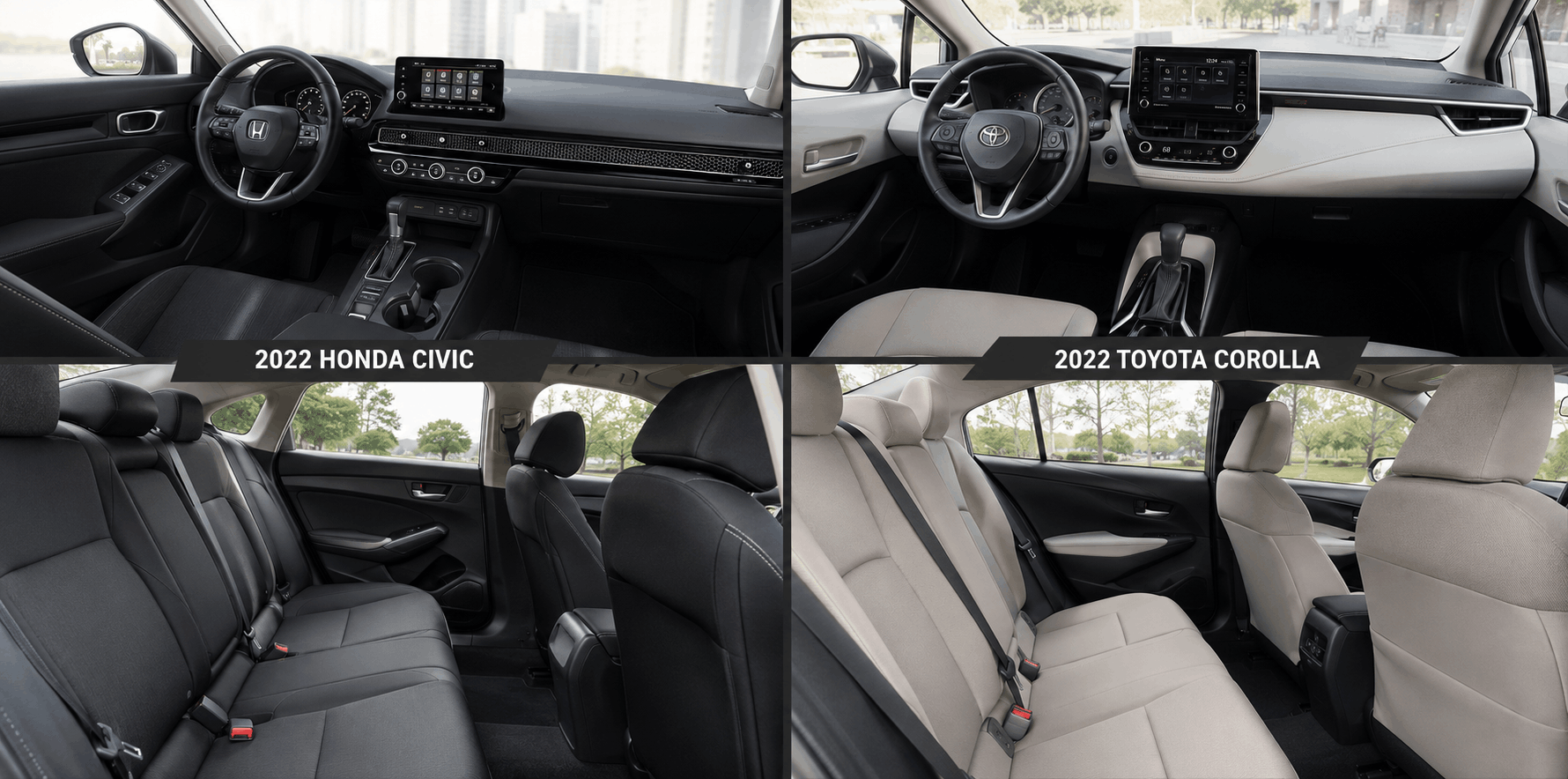
Interior Space and Tech Cutoffs: The Practical Gap
If you frequently carry adult passengers or load up groceries, the interior measurements tell a major story.
The Passenger and Cargo Gap
The Civic is notably roomier. It offers roughly 37.4 inches of rear legroom compared to the Corolla’s 34.8 inches. The Civic’s trunk space is also more generous (~14.8 cubic feet vs. the Corolla’s 13.1 cubic feet). That’s a meaningful edge for road trips and cargo hauling.
The Smartphone Tech Timeline
If Apple CarPlay and Android Auto are non-negotiable, keep these years in mind.
Most Civic trims have featured both standards since 2016. On the Corolla, Apple CarPlay became standard for the 2019 model year. Android Auto wasn’t standard across the board until 2020.
Safety: Honda Sensing vs. Toyota Safety Sense
Both the Civic and Corolla include strong driver-assistance suites as standard equipment across most of the 2018–2023 range.
Both cover the core features: automatic emergency braking, forward collision warning, adaptive cruise control, and lane-keeping assist. Toyota’s system also includes pedestrian detection as standard across its Corolla lineup.
On timing: Toyota Safety Sense has been standard on every Corolla trim since 2018. The 2019 redesign upgraded to TSS 2.0, adding enhanced night-time pedestrian and cyclist detection. Honda Sensing became standard on all Civic trims from the 2019 model year onward.
Resale Value and Used Pricing
Both the Civic and the used Toyota Corolla hold their value better than almost anything else in the compact class. That’s good news when you sell or trade in later, and a challenge when you’re buying, because clean, low-mileage examples don’t sit on a lot for long.
Smart buyers get their financing sorted before falling in love with a specific car. With Carz4Us, you can get pre-qualified with a soft credit check that will not impact your score. It lets you see real numbers instantly so you can move fast when the right car lands. Plus, we work with all credit profiles.
Best Used Years to Buy and Model Trends to Watch

Used Honda Civic Milestones (2016–2023)
The 2016 model year launched the highly successful 10th-generation Civic, but early production months saw minor complaints regarding infotainment lag and steering rack noise. Models from 2019 to 2021 represent the sweet spot for reliability, featuring physical buttons for the volume control and standard safety gear. The 11th-generation Civic launched for 2022, offering an incredibly premium cabin design and updated safety structures.

Used Toyota Corolla Milestones (2014–2023)
Models from 2014 to 2016 are incredibly robust mechanically, though some owners reported early CVT transmission software hesitations that dealers fixed via updates. The Corolla crossed into its current generation for the 2020 model year, which brought a vastly improved multi-link rear suspension that made the car much smoother on bumpy roads. The 2020 model year also marked the debut of the ultra-efficient Corolla Hybrid in the United States market.
The Used Buyer’s Sweet-Spot Trims
The Civic Value Pick: Look for a used Civic EX. It serves as the ultimate sweet spot for the 10th generation, unlocking the punchier 1.5L Turbo engine, standard Apple CarPlay/Android Auto, and heated front seats without paying the pricing premium of the Touring model.
The Corolla Value Pick: Look for a used Corolla LE (for pure budget) or Corolla SE (for styling). The LE is the most common model on used lots and provides the best dollar-for-feature value, while the SE adds sharper exterior looks and slightly firmer tuning if you want a touch more road feel.
Buying a Used Civic or Corolla in New Jersey
This is where a national “Civic vs. Corolla” article stops short, and where NJ ownership actually differs.
Mind the road salt. Northern-NJ winters mean salted roads, and salt is hard on any car’s undercarriage. Older Civics in particular have a known reputation for rusting a bit sooner than the Corolla. On any used compact, check the underbody, wheel wells, and brake lines, not just the paint.
Highway miles vs. city commutes. If your commute is mostly Parkway or Turnpike cruising, prioritize highway MPG and a relaxed ride. If you’re fighting stop-and-go traffic around Hackensack, Paterson, or Morristown, a hybrid’s city efficiency pays off considerably more.
Emissions vs. Safety Inspections. New Jersey’s periodic inspection is an OBD-II emissions scan, not a mechanical safety check. Get a proper pre-purchase inspection done on any used car, regardless of what the state requires.
Insurance and Registration Costs. NJ has higher-than-average insurance and registration costs. Factor total cost of ownership, not just sticker price, into the Civic-vs-Corolla math. Both are relatively affordable to insure compared to the rest of the segment.
Shopping the Bergen and Morris County corridor? Carz4Us has two convenient locations right on Route 46:
- South Hackensack: 368 Main St (just off Route 46)
- Pine Brook: 20 US-46 (directly on Route 46)
Both lots carry active used Honda Civic and used Toyota inventory, with a free CARFAX on every single listing.
How to Choose: The Final Verdict
Go with the used Honda Civic if you want the more engaging drive, a roomier and more modern-feeling interior, more body-style choices, and a small edge in retained value.
Go with the used Toyota Corolla if you want the lowest-stress ownership, the simplest maintenance, and the best fuel economy, especially in Hybrid form.
The smartest buying strategy is to view a specific Civic and a specific Corolla side by side, review their unique CARFAX records, and let real-world condition make your choice easy.
Find Your Used Civic or Corolla at Carz4Us
We carry both, so you can cross-shop a used Honda Civic and a used Toyota Corolla side by side at one of our two northern-NJ locations.
Every vehicle comes with a free CARFAX, you can pre-qualify in minutes with a soft credit pull that won’t affect your score, and we work with all credit profiles.
Visit us at our South Hackensack location (368 Main St, just off Route 46) or our Pine Brook location (directly on 20 US-46), Monday through Saturday 10am–7pm (closed Sundays), or call (855) 227-9487 to check what’s in stock today.
FAQ
Is a used Honda Civic or Toyota Corolla more reliable?
Both are exceptionally reliable and commonly last 200,000-plus miles with regular maintenance. The Corolla has a slight edge for sheer mechanical simplicity, fewer moving parts, no turbo, with the Civic close behind. On any individual used car, documented service history matters more than the brand, which is why we include a free CARFAX on every listing.
Which car costs less to repair and maintain?
Both are among the cheapest compact cars to own. The Corolla averages approximately $362/year in repair costs and the Civic approximately $368/year, per RepairPal. The gap is minimal. The bigger risk with the Civic is buying one with a neglected oil-change history on the turbo engine, which can cause costly repairs down the line.
Which model offers better overall fuel economy?
Standard gasoline versions of both cars are highly competitive, returning highway numbers in the high-30s to low-40s range. The Toyota Corolla Hybrid is the undeniable efficiency leader for these model years, delivering an EPA-estimated 52 MPG combined for 2020–2022 models. Honda did not offer a Civic Hybrid in the United States during the 2018–2023 model years.
Does a used Civic or Corolla hold its resale value better?
Both vehicles represent the gold standard for residual value retention in the compact segment. The Civic often commands a minor pricing premium on the used market due to higher initial demand for its tech features, but both options protect your investment well when it comes time to trade the vehicle in.
What are the main safety feature differences between the two cars?
Both cars offer excellent collision avoidance suites. Toyota Safety Sense became standard across the entire Corolla lineup for the 2018 model year, while the Honda Sensing suite became standard across all Civic models starting in 2019. Both systems provide adaptive cruise control, lane-keep assist, and automatic emergency braking functions.
What should New Jersey drivers check when buying a used compact car?
NJ car buyers should prioritize inspecting the vehicle’s undercarriage for road salt corrosion or rust. Additionally, consider your commute: stop-and-go driving near local urban centers favors the Corolla Hybrid, while long highway stretches on the turnpike maximize the stability and cabin comfort of the Honda Civic.