
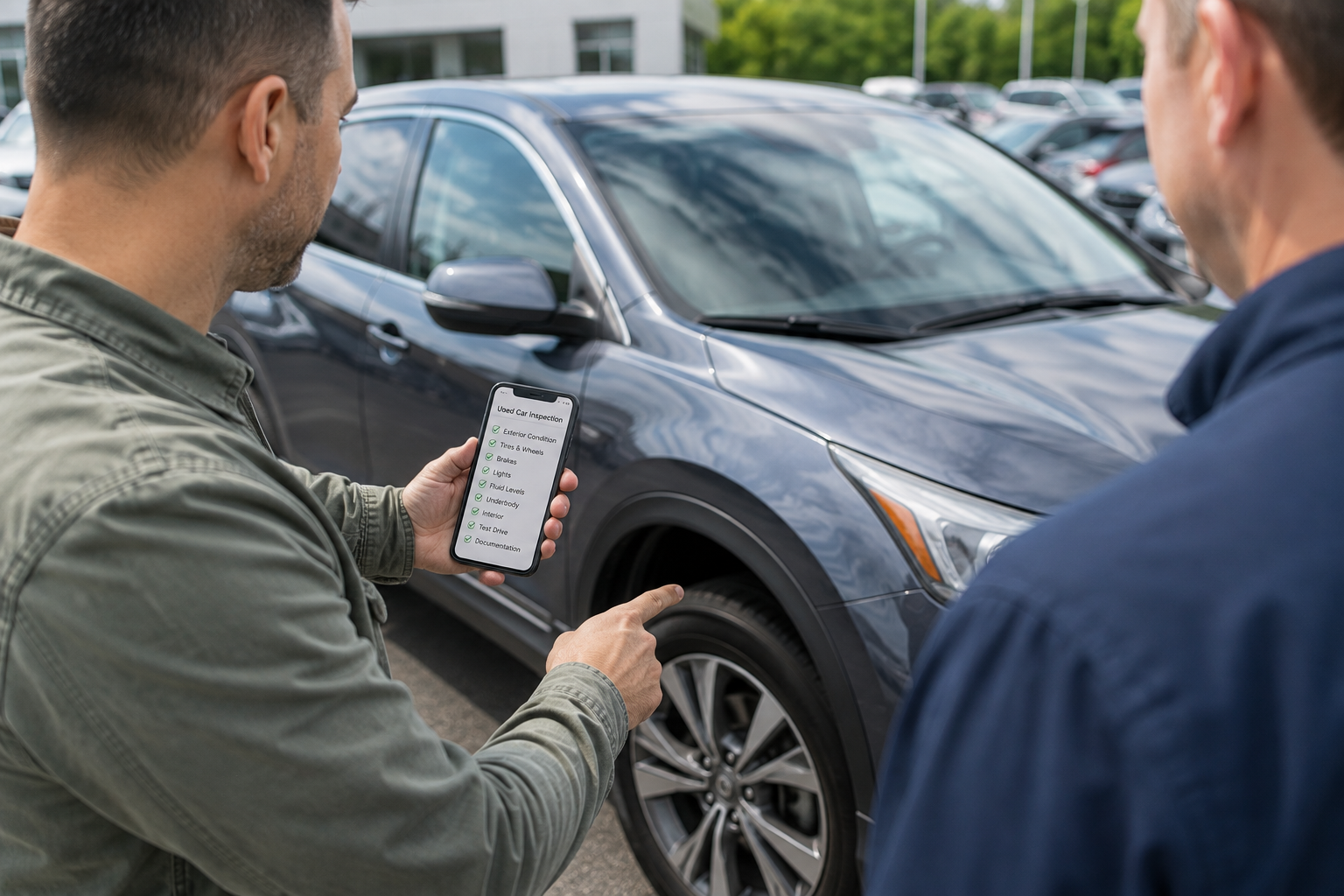

Most buyers walk onto a lot focused on the car. The smarter move is to focus on what the car is not showing you.
A used vehicle can look perfect in photos and read clean on a quick walkthrough. It can still hide a corroded frame, an unrepaired recall, or a loan structure that costs you $3,000 more than the sticker suggested.
The questions you ask determine whether you buy a reliable vehicle or spend the next year managing surprises. The order you ask them matters just as much.
This list is built for New Jersey buyers. It covers everything Ramsey, NerdWallet, and Experian include, plus the two questions those national guides consistently skip: undercarriage rust from NJ road salt, and the gap in what the state inspection actually tests.
Keep it on your phone. Use it at the lot.
Top 5 Questions Before Anything Else
- Can I see the vehicle history (CARFAX) report? Non-negotiable starting point; free on every Carz4Us listing.
- Does the car have any open recalls? Dealers can legally sell used cars with open recalls. Always verify at nhtsa.gov.
- What is the full out-the-door price, with every fee included? Never negotiate on monthly payment; this is the number that matters.
- Can I take it to an independent mechanic for a pre-purchase inspection? A refusal is a red flag worth walking away from.
- Can I pre-qualify without a hard credit pull? Know your number before you fall for a specific car.
Questions to Ask About the Car’s History
Pull the history before you step inside the car. What you find there shapes every question that follows.
Can I see the vehicle history report?
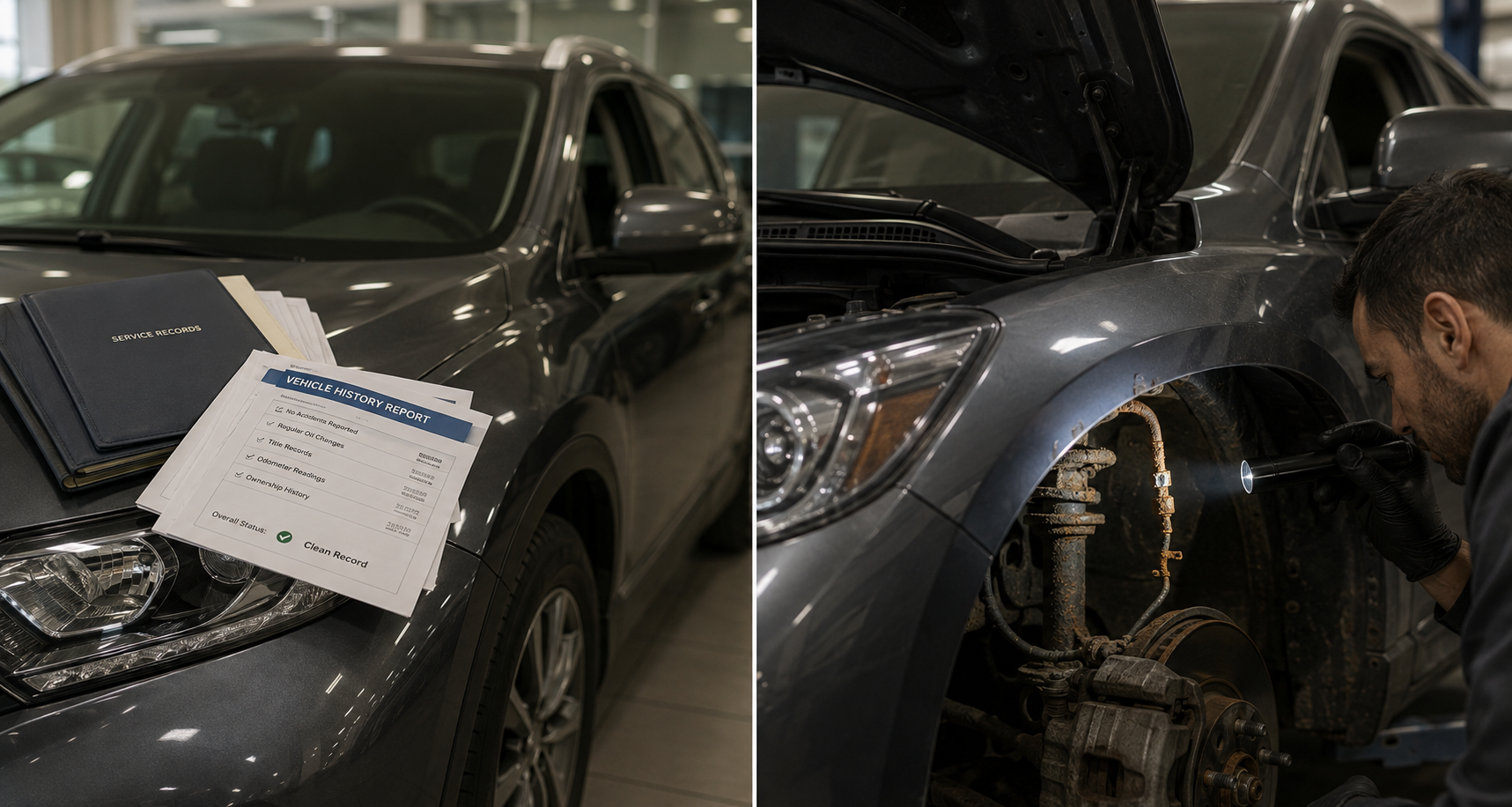
Non-negotiable and first. A full CARFAX reveals title status, reported accidents, number of previous owners, odometer readings, and often documented service history. At Carz4Us, the report is free on every listing and accessible before you drive to either lot. A seller who hesitates to hand it over is already telling you something.
Does this vehicle have any open safety recalls?
This is the question most guides bury in a footnote, and it is one of the most important. Federal law prohibits dealers from selling new cars with unrepaired recalls, but used cars have no such protection. According to Consumer Reports, dealers can legally sell a used vehicle with an outstanding safety recall. The National Highway Traffic Safety Administration (NHTSA) confirms that no federal law requires used car dealers or private sellers to complete recall repairs before a sale.
Run a free recall check at nhtsa.gov/recalls using the car’s VIN before you buy. If there is an open recall, ask the dealer to provide documentation that it has been repaired, or request that it be repaired before purchase. Recall repairs are free at any authorized dealership. If the seller refuses to address it, that is a firm reason to walk.
Why This Matters: A clean CARFAX does not always flag every open recall. Buyers who skip the separate NHTSA check risk discovering an unrepaired safety recall months later, often at a routine dealership visit. The fix is free once flagged. The thirty-second VIN check at nhtsa.gov/recalls is what closes that gap before you buy.
How many previous owners, and were any of them commercial or rental operators?
Fewer owners usually means a more predictable maintenance history. Commercial and rental use matters separately. A two owner car where the first owner was a rental fleet has been driven hard by strangers on compressed timelines. The CARFAX will often flag this. Ask directly if it is not clear.
Are there documented service records?
Consistent maintenance records matter more than mileage alone. A 2019 Honda CR-V with 95,000 miles and a complete service file is often a more reliable purchase than a same-model car at 70,000 miles with nothing documented. Ask to see what is available on the lot.
Why is the car being sold?
- At a dealership: The answer is usually simple, a trade-in or acquisition.
- At a private sale: This question is worth asking and watching closely. A clear, specific reason, such as upgrading to a truck for work, reads differently than a vague deflection. The seller’s reaction often tells you as much as the words do.
Questions to Ask About Vehicle Condition
National guides give you basic advice: check the tires, look for scratches. New Jersey requires two specific condition checks no national guide mentions.
The NJ Salt Belt Reality (AAA Warning): According to a February 2026 AAA warning, road salt accelerates rust on brake lines, suspension systems, and structural components. Corrosion is classified as normal wear and tear, meaning standard auto insurance will not cover it. In New Jersey’s salt belt, this is relevant on any vehicle with winter history here.
Has the undercarriage been checked for rust? The NJ Question
This is the most important condition question for a New Jersey buyer, and the one no national guide includes. NJ road salt attacks brake lines, fuel lines, and frame components from underneath, damage that is invisible on a walkthrough and undetectable on a test drive. On any truck, SUV, or vehicle over four years old, request a lift inspection and ask specifically about the frame, brake lines, and fuel lines.
| Rust Severity | Repair Cost (excl. paint) |
|---|---|
| Surface rust (cosmetic, body panels) | Manageable, low cost |
| Moderate (6–12 in., no perforation) | $200–$300 |
| Major (perforation / panel replacement) | $400–$2,000 |
| Frame-level corrosion | Top of range or beyond |
Source: CoPilot rust repair cost breakdown.
Flood damage does not always reach the title. During the walkthrough, use your senses: a musty or moldy smell, damp or freshly shampooed carpets, rust in places water should never reach (seat rails, under the dash), and condensation inside the headlights are all worth stopping on. In a state with New Jersey’s flood history, this check costs nothing and catches a category of problem no report is guaranteed to flag.
May I have this car independently inspected by my mechanic?
New Jersey’s state inspection is emissions only. It confirms the car passes air quality standards. It does not evaluate brakes, suspension, frame integrity, transmission health, or corrosion. A car can pass the NJ inspection and still have serious mechanical problems.
- PPI Cost vs. Benefit: An independent pre-purchase inspection runs $183 to $322 according to RepairPal, close to 1% of the 2026 average used car price of roughly $26,000 (Kelley Blue Book). Ask whether the dealer allows an outside shop or a mobile mechanic on-site; the answer tells you something about the car.
Red Flag: A dealer who refuses an independent pre-purchase inspection is telling you something about the car, not just about themselves. Walk away and find the same model elsewhere. The North Jersey market moves fast, but not fast enough to skip this step.
For hybrids and EVs: what is the battery state of health?
On a used hybrid or electric vehicle, battery state of health is the single most informative number available. A battery at 75% of original capacity is not the same vehicle as one at 91%, even if the sticker price is identical. Ask the dealer to pull this reading, or have an independent mechanic do it during the PPI.
What should I look for during the test drive?
A test drive doesn’t replace a mechanic’s lift, but it reveals performance red flags. Drive on local roads and a stretch of highway with the radio turned off for the first five minutes.
- Listen for: Grinding or squealing brakes, clunks over bumps, or transmission hesitation.
- Feel for: Pulling to one side during braking, highway speed vibrations, or rough gear shifts.
Questions to Ask About Price & Financing
The advertised sticker price is just a starting point. The only number that matters is the total amount coming out of your bank account.
Before you negotiate anything, know what the car is worth. Pull the fair-value range from KBB and Edmunds for the exact trim, mileage, and condition before you arrive at the lot. The out-the-door conversation goes very differently when you open with a documented market number instead of reacting to the sticker.
Is this car certified pre-owned, and what does that actually mean?
- Franchise Dealers: Certified pre-owned (CPO) is a manufacturer-backed inspection and warranty program, priced accordingly.
- Independent Dealers (like Carz4Us): Can’t sell CPO. What replaces it is documented history, a free CARFAX on every listing, and your own independent pre-purchase inspection.
If you are weighing that trade-off, our certified pre-owned vs. traditional used comparison breaks down what the certification premium actually buys.
What is the full out-the-door price, with every fee?
Never negotiate on monthly payments alone. Dealers can easily mask a bad deal by stretching your loan term. Negotiate only on the total out-the-door (OTD) price.
Vehicle Sticker Price
+ 6.625% NJ Sales Tax
+ Title & Registration Fees
+ Dealer Documentation Fee
= Total Out-The-Door Price (Your Negotiating Number)
How long has this car been on the lot?
This is the question buyers use to negotiate, and most skip it. Floorplan financing means every car sitting on a dealer’s lot costs the dealer money in daily interest. A vehicle with 60 or more days on lot represents meaningful cost pressure on the dealer’s side, and more room to negotiate on yours. CarGurus and AutoTrader list days-on-lot data directly in their search results. Check it before you arrive.
Consider a Typical Scenario: A buyer comparing two nearly identical SUVs online notices one has sat listed for 12 days and the other for 74. On the 74 day car, the buyer opens negotiation by referencing the listing duration directly rather than the price alone. This does not guarantee a bigger discount, but it changes the conversation from is this price fair to why hasn’t this sold yet. That is a materially different negotiating position.
Is the car still under any factory or dealer warranty?
- Ask Specifically: How much factory warranty coverage remains, what it covers, and whether it’s transferable. If the car is outside factory coverage, ask about extended options; Carz4Us offers extended protection through Allstate and other nationally recognized providers.
- Get It in Writing: Who provides the coverage, what’s included, what’s excluded, and whether there’s a deductible.
- Pro tip: Get an insurance quote on the exact VIN before signing. New Jersey premiums run well above the national average and vary by model. The quote takes minutes and belongs in your out-the-door math, not your first month of ownership.
Can I pre-qualify without affecting my credit score?
At Carz4Us you can pre-qualify with a soft credit check through Capital One that will not affect your score, and we work with 20+ lenders across all credit profiles, including first-time buyers and those rebuilding after a financial setback. Ask a team member at either location for details.
Pre-qualifying before you fall in love with a specific car keeps you in control. Know your number first. It also shows the dealer you are a serious buyer, which changes the dynamic before negotiation starts.
Questions About the Title, Dealer, and After-Sale Protection
The car and the dealer are two separate evaluations. A clean car from a dealer you cannot trust creates problems after the lot.
Is the title clean, and is it in hand?
Ask directly about title status before going further.
- Clean title: No liens, no salvage designation, no flood damage flag.
- Salvage title: The car was previously declared a total loss by an insurance company. It may have been repaired, but it carries ongoing resale and insurance implications.
- Liened title: A lender still has a financial interest in the vehicle. At a licensed NJ dealership, lien clearance is handled as part of the sale. At a private sale, verify the title is in hand and lien-free before any money changes hands.
Is the dealer licensed in New Jersey?
Licensed NJ dealers are registered with the New Jersey Motor Vehicle Commission and must comply with state consumer protection regulations. Ask directly, or look up the dealer on the NJMVC dealer lookup. A licensed dealership gives you legal recourse you do not have in a private transaction.
What does the FTC Buyer’s Guide in the window say?
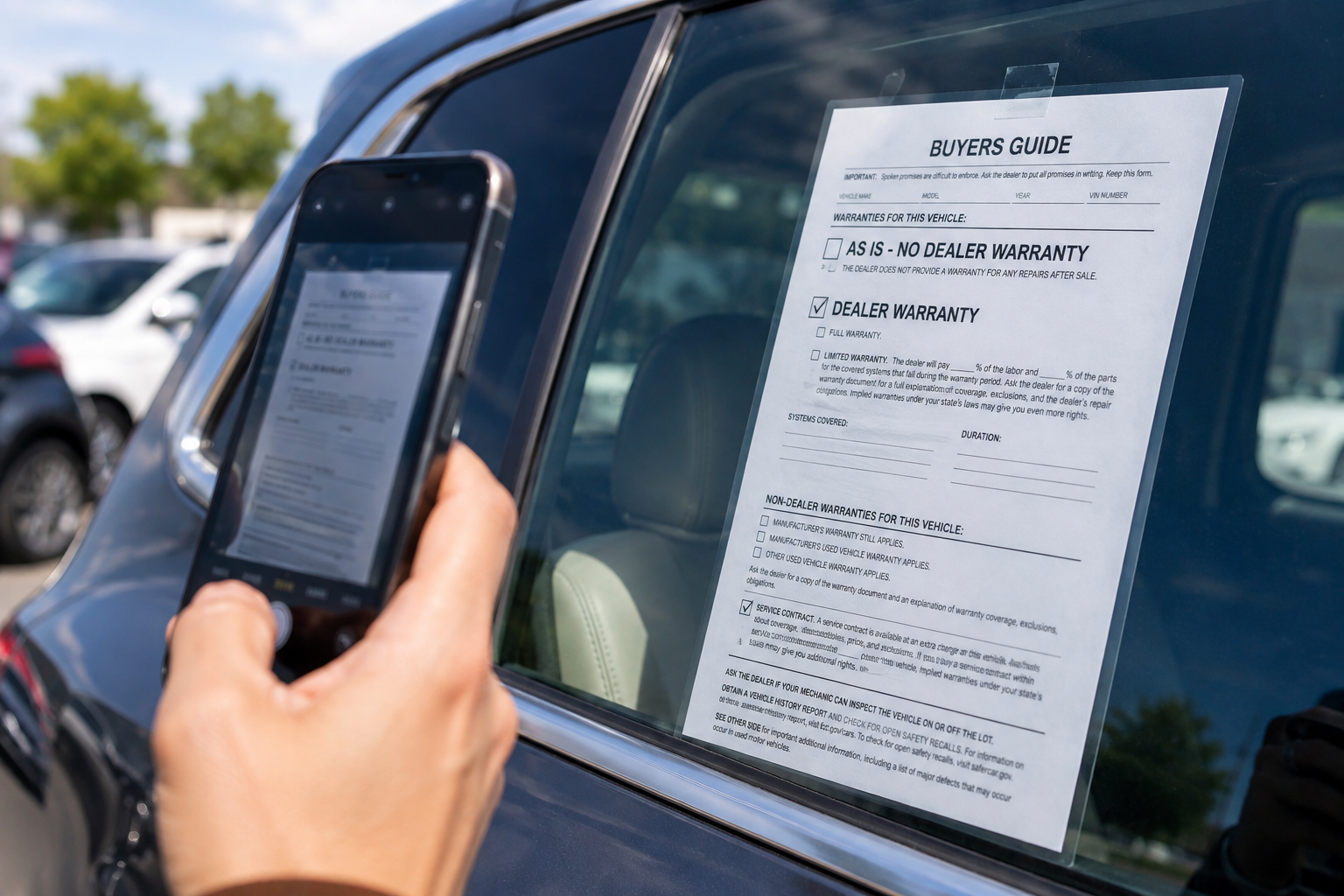
Before you ask a single question, read the one answer federal law already requires. The FTC’s Used Car Rule requires every dealer to display a Buyer’s Guide on each used car offered for sale. It states whether the car is sold as-is or with a warranty, and if there is a warranty, what it covers.
What the Buyer’s Guide says overrides anything a salesperson tells you verbally; if a promise is not written into it, treat the promise as if it was never made. Photograph it before your test drive.
Does this car qualify for the NJ Used Car Lemon Law warranty?
New Jersey requires licensed dealers to provide a written warranty on used cars priced over $3,000 that are seven model years old or less with 100,000 miles or fewer, with coverage length scaled to mileage at the time of sale.
| Mileage at Sale | Warranty Coverage |
|---|---|
| Under 24,000 miles | 90 days or 3,000 miles |
| 24,001–59,999 miles | 60 days or 2,000 miles |
| 60,000–100,000 miles | 30 days or 1,000 miles |
For vehicles with 60,000 miles or more, you can be asked to waive the warranty in writing. Understand exactly what you are giving up before you do. Full details in our complete guide to buying a used car in NJ.
What is the return or exchange policy, and is there any after-sale protection?
Understand what happens after you sign, before you sign. Ask whether the car is sold as-is or with any warranty coverage. Get the answer in writing.
For buyers who want additional peace of mind, Carz4Us offers extended protection plans through Allstate. Ask for details at either location.
For a full walkthrough of how to evaluate a North Jersey used car dealer before you buy, see our guide on how to vet a NJ used car dealer.
Additional Questions for Private Seller Purchases in NJ
A private sale can offer a lower price, but it comes with fewer protections. These questions are specific to buying from an individual rather than a licensed dealer.
- Do you have the title in hand, and is there a lien on the vehicle?
- How many sets of keys come with the car? Replacements run $200 to $400 for key fob equipped vehicles.
- Do you have service records?
- Has the car had any work done that didn’t show up on the CARFAX, such as cash repairs at an independent shop?
- Why are you selling now?
At a private sale, you are also responsible for running the NHTSA recall check yourself, since private sellers have no obligation to disclose open recalls. Pull it at nhtsa.gov/recalls before you pay.
What Skipping These Questions Actually Costs
Scenario: A buyer purchases a used truck with a clean CARFAX and a recent emissions pass, then skips the independent inspection because the truck “looked well-maintained.”
Outcome: Months later, a mechanic finds corroded brake lines on the rear axle, a result of salt exposure the emissions test never evaluates, and the repair runs well into four figures.
Takeaway: A pre-purchase inspection would have cost under $300 and taken about an hour. That’s the gap this list is built to close.
Where These Questions Fit in the Buying Process
These questions to ask when buying a used car belong at the lot, before negotiation begins. For the full step-by-step buying process, from setting a budget to signing the paperwork, see the complete guide to buying a used car in NJ.
For a physical checklist to use during the walk-around and test drive, pair this list with the hands-on used car buying checklist.
Find Your Next Used Car at Carz4Us
Carz4Us makes this process more transparent from the start. Every vehicle across both Route 46 locations includes a free CARFAX report available on the listing page before you visit. The 60-second Capital One pre-qualification shows you what you qualify for without touching your credit score. The team works with 20+ lenders across all credit profiles.
Visit our South Hackensack location (368 Main St, Bergen County) or our Pine Brook location (20 US-46, Morris County), Monday through Saturday, 10am to 7pm, closed Sundays. Call (855) 227-9487 to check inventory, or browse used cars in NJ and pull a CARFAX before you make the drive. Ready to see your numbers first? Get pre-qualified for financing before you visit either lot.
Frequently Asked Questions
What is the most important question to ask when buying a used car?
Asking to see the vehicle history report is the first step, but the recall check runs a close second. Dealers can legally sell used cars with unrepaired open safety recalls in New Jersey. A free NHTSA recall check at nhtsa.gov/recalls using the car’s VIN takes thirty seconds and should happen before you discuss price.
What is out the door price, and why does it matter in NJ?
Out the door price is the total you pay: vehicle price plus New Jersey’s 6.625% sales tax, title fees, registration, and dealer documentation fees. On an $18,000 vehicle, that adds roughly $1,300 to $1,800 on top of the sticker. Always negotiate on this total, not the monthly payment. Always get it in writing before the finance office conversation.
Is it rude to ask for an independent pre-purchase inspection?
Not at all. Any reputable dealer welcomes the request. In New Jersey, where the state inspection does not evaluate mechanical condition, asking for an independent PPI is standard practice. A dealer who refuses should be treated as a red flag, not a dealbreaker from your side.