
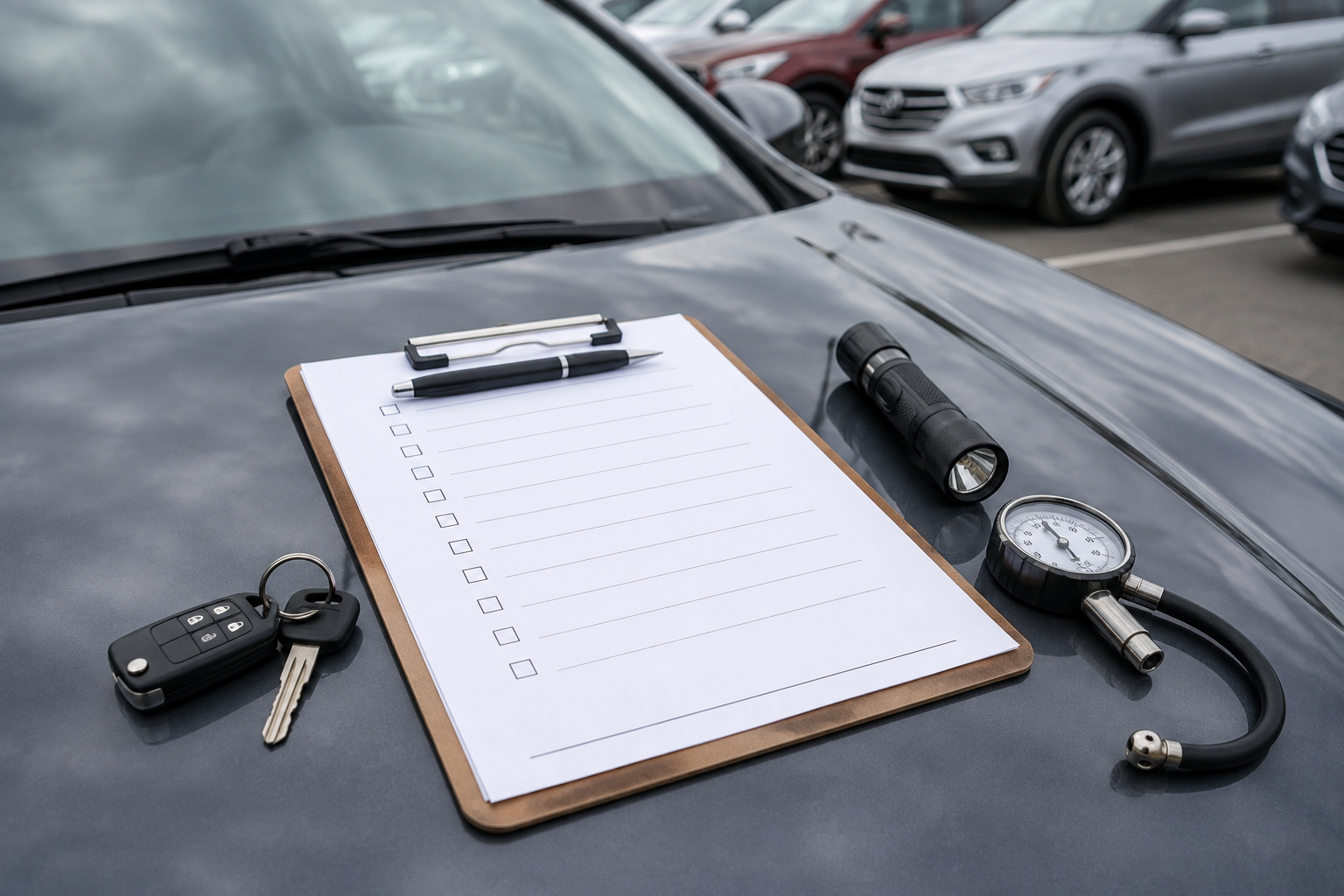

Four thousand miles. That’s how long it took for a transmission to start slipping on a car that sailed through a five-minute test drive. The seller wasn’t lying. He never mentioned what a longer drive would reveal.
That’s the trap you can walk into: a car staged to look its best, on a timeline built for you to decide fast. This checklist comes from our North Jersey mechanics’ daily inspections, built around what fails here: road salt corrosion, an emissions-only inspection that skips mechanical safety, and a market averaging $26,918 per vehicle, per Kelley Blue Book / Cox Automotive.
Quick Answer: The 4-Phase System
A used car buying checklist is a structured, four-phase process: budget and history first, then a hands-on inspection, a deliberate test drive, and a documented negotiation, worked through in order before you sign anything. Following the sequence prevents the two costliest mistakes you can make: skipping the inspection and rushing the paperwork.
- Before you go: budget, pre-qualify, pull the vehicle history report.
- Inspect: body, undercarriage, tires, brakes, interior, electronics.
- Test-drive: cold start through highway speed, deliberately.
- Negotiate & close: out-the-door price, paperwork, no rushing.
Prefer it on paper? Download the printable one-page version of this checklist and fill it out at the lot, one sheet per car you look at. carz4us-used-car-checklist.pdf
Work through these four phases in order, and by the time you’re signing paperwork, you’ll already know more about this car than a five-minute test drive would ever tell you.
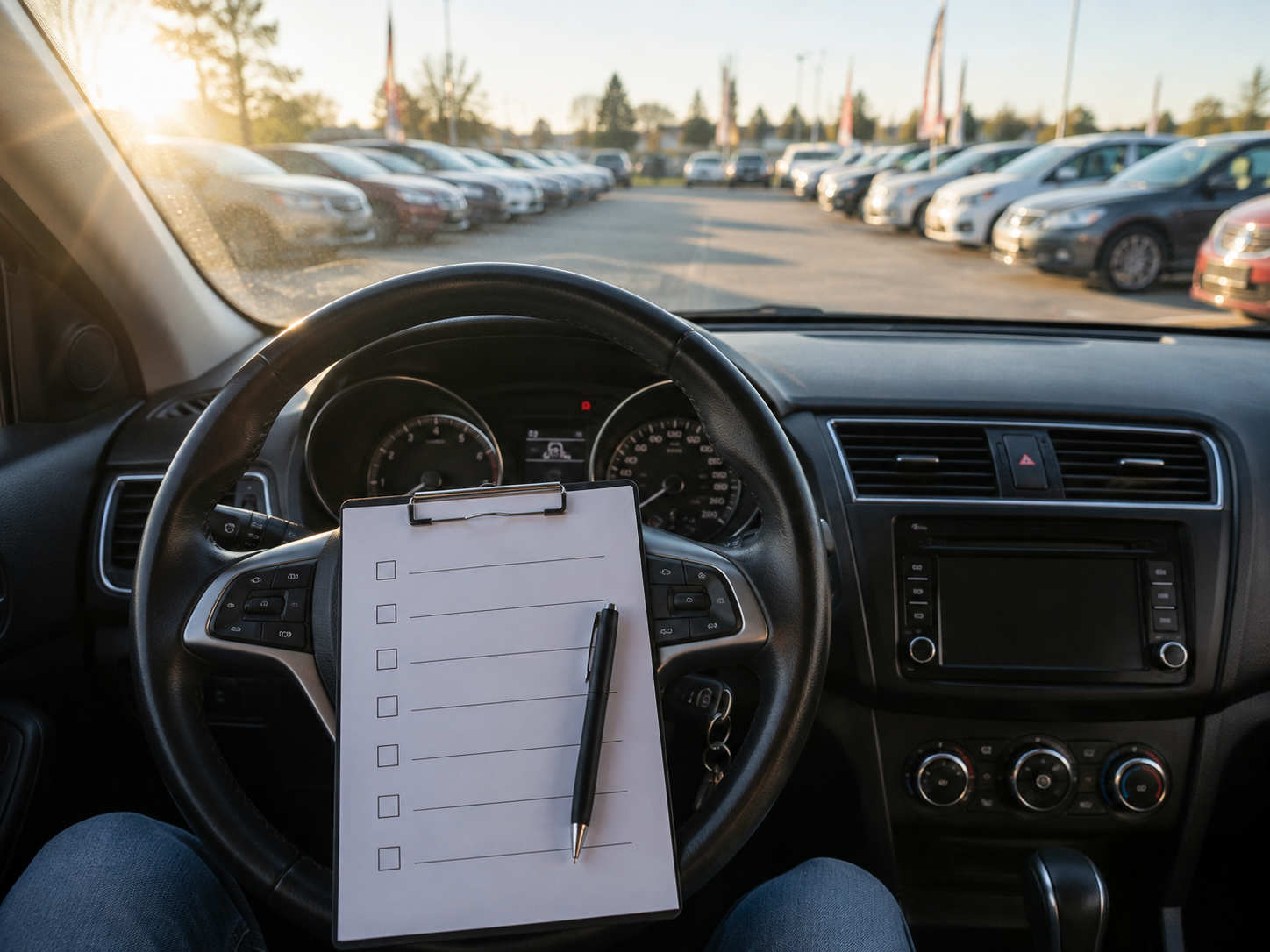
The NJ Used Car Checklist, Phase 1: Before You Go
Don’t skip Phase 1. If you do, you’ll walk onto the lot with zero leverage, and you’ll end up negotiating against a seller who already knows more about the car than you do.
- Set your out-the-door budget, including New Jersey’s 6.625% sales tax, registration, and insurance.
- Check the fair market value on KBB and Edmunds for the exact trim and mileage, so you know what the car is worth before anyone tells you.
- Pre-qualify with a soft credit check that won’t affect your score.
- Read the vehicle history (CARFAX) report, free on every Carz4Us listing, before you drive out.
- Confirm trim, mileage, options, and drivetrain (FWD vs. AWD).
- Vet the dealer before you commit to the drive. Our guide to choosing a reliable NJ used car dealer covers every green and red flag.
Pro tip: A CARFAX or AutoCheck report is a start, not a guarantee. It shows accidents and title issues. It doesn’t show whether the oil was changed on schedule. Ask the seller for maintenance receipts too.
Phase 2: The Used Car Inspection Checklist
Phase 2 is where most lemons get caught, and it takes longer than you’d expect. Budget twenty minutes, not five.
These are the used car red flags you’ll run into most often in NJ, paired with what each one usually means and what to do about it:
Exterior & Structural Check
- Body & paint: panel gaps, mismatched paint that can hint at prior repairs.
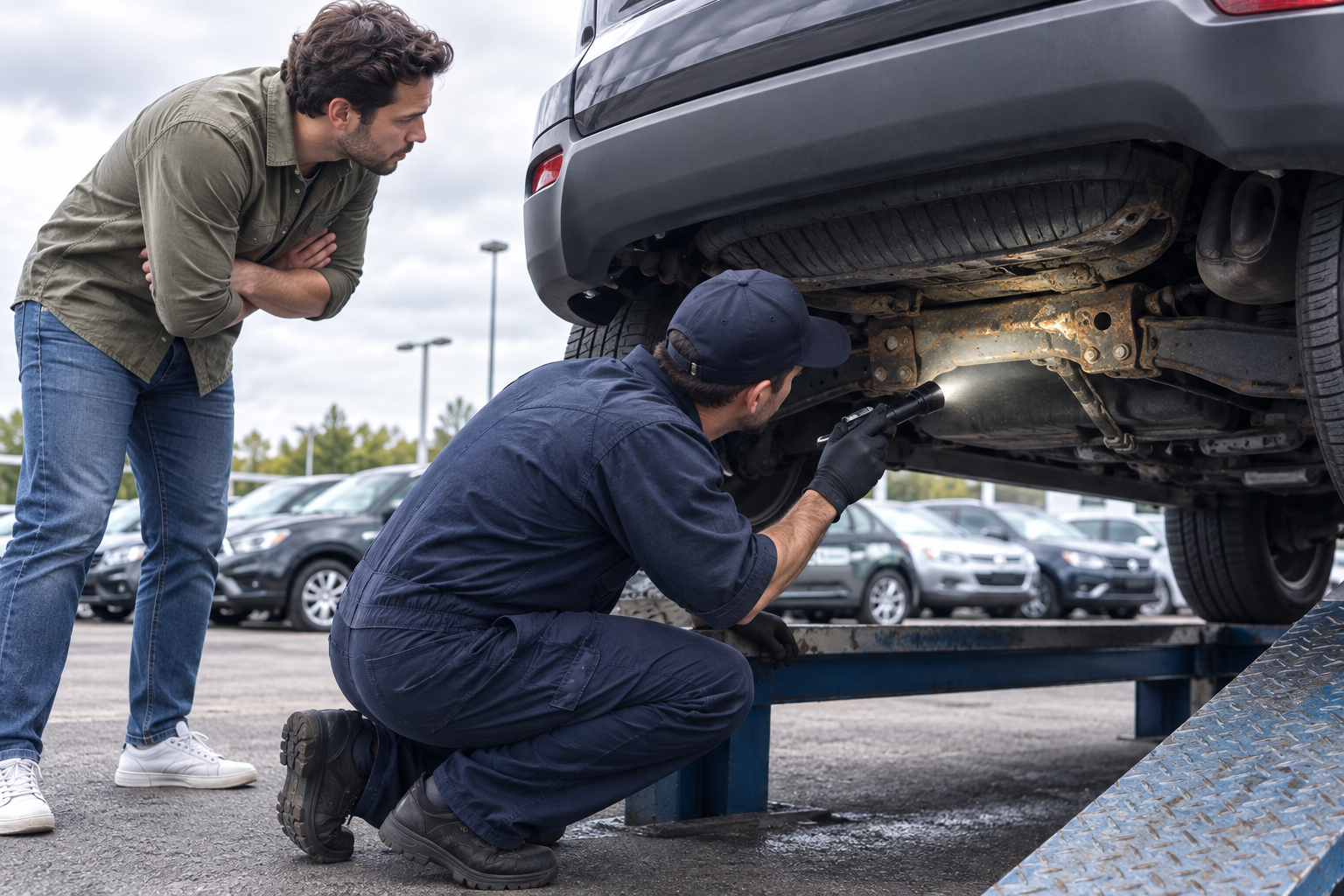
- Undercarriage (the NJ step): brake lines and fuel lines, and on trucks and SUVs, the frame, checked for salt corrosion.
- Tires: even tread and matching tires; uneven wear signals alignment or suspension issues.
- Glass: windshield chips and cracks. NJ freeze-thaw cycles turn a small chip into a spreading crack by February.
- Lights & lenses: every exterior light works, no cracked or heavily fogged lenses.
- Suspension: push down firmly on each corner. The car should rebound once and settle. Continued bouncing means worn shocks or struts.
Mechanical, Fluids & Electronics
- Cold-start exhaust: watch the smoke at startup. Blue smoke suggests burning oil; white smoke that lingers after warm-up suggests coolant.
- Brakes: pad and rotor condition; listen for grinding on the drive.
- Fluids: oil, coolant, and transmission fluid clean and at proper levels.
- Interior & electronics: A/C and heat, infotainment, cameras, windows, warning lights.
- Hybrid/EV only: request a battery state-of-health reading.
| Red flag | What it usually means | Your move |
|---|---|---|
| Mismatched paint or panel gaps | Prior collision repair | Ask for the body-shop invoice, or walk. |
| Fresh undercoating on an older car | Possible attempt to mask rust | Request an independent lift inspection. |
| Freshly cleaned engine bay | Could be hiding a leak | Have a mechanic check for residue after a drive. |
| Uneven tire wear | Alignment or suspension issue | Budget for an alignment, or negotiate the price down. |
| Warning light taped over or dark | Possible sensor tamper or pulled bulb | Walk away, or demand a diagnostic scan. |
None of these is an automatic dealbreaker on its own. Two or more together is a hard pass.
Phase 3: Test-Drive Deliberately
Phase 3 is the only phase you can’t fake with paperwork. The car either behaves, or it doesn’t.
- Cold-start the car if you can, since some issues only show cold.
- Reach highway speed to check for vibration, wandering, or transmission hesitation.
- Brake firmly (safely) to feel for pulling or pulsing.
- Turn the wheel lock to lock at low speed and listen for noises.
- Drive with the radio off for the first few minutes.
Cold-starting the engine and killing the radio are two tricks worth stealing, and Consumer Reports backs both for the same reason: a warmed-up, music-filled test drive hides problems a cold, quiet one exposes immediately. Add one NJ-specific check: feel the front passenger floor mats for dampness during the quiet drive. A wet carpet with a sweet smell points to a leaking heater core, a costly repair that harsh local winters accelerate. Watch for musty odors, damp carpet elsewhere, or rust in places water shouldn’t reach, like seat rails or under the dash. Flood damage doesn’t always show up on the title, and New Jersey sees enough flooding to make this worth checking on every car.
Phase 4: Negotiate and Close
Phase 4 only works if Phases 2 and 3 gave you something to negotiate with.
- Negotiate on the total out-the-door price, not the monthly payment.
- Get every fee itemized in writing before you agree.
- Don’t rush. A fair dealer gives you time to read everything.
- Verify paperwork: title, odometer, and sales agreement match the car.
- Match the VIN on the dashboard and the driver’s door jamb to the VIN on the title. If they don’t match, stop. Nothing else on this list matters.
- Read the Buyer’s Guide posted in the window. Federal law requires it, and what it says about as-is or warranty status overrides anything you were told verbally. Photograph it before you sign.
Here’s how this typically plays out. Picture yourself at our Pine Brook lot, running the Phase 2 undercarriage check on a low-mileage SUV that looks flawless everywhere else. Underneath, the rear subframe shows surface rust consistent with a few winters of road salt exposure.
Instead of walking away, you have real leverage: several hundred dollars off the price, plus a rust-proofing treatment before delivery. The car isn’t a bad buy. It’s a normal used car with leverage nobody used yet, which is the entire point of working the checklist in order instead of skipping straight to the test drive.
Why Buying a Used Car in New Jersey is Different
Two New Jersey realities shape what you need to check.
1. The Salt-Belt Corrosion Factor
The National Highway Traffic Safety Administration advises owners of vehicles from model year 2007 and earlier in salt-belt states, New Jersey included, to have brake lines inspected regularly for corrosion-related failure risk. That’s why Phase 2’s undercarriage check isn’t optional here the way it might be if you were shopping in Arizona.
2. The Limits of NJ’s Emissions-Only Inspection
New Jersey’s state inspection is emissions-only. It never touches brakes, tires, or suspension, so a car can pass inspection with worn brake pads or a failing tie rod. An independent pre-purchase inspection closes that gap on any car you’re seriously considering.
Complete Your NJ Buying Playbook
- For the specific questions to pair with this checklist, see our questions to ask before buying a used car in NJ.
- For the full process end to end, start with the complete guide to buying a used car in NJ.
Find Your Next Used Car at Carz4Us
Shopping for a used car in North Jersey doesn’t have to be stressful. At Carz4Us, we make the process transparent from day one.
- Free CARFAX on Every Listing: Review full vehicle history reports online before you ever leave your house.
- Soft-Pull Pre-Qualification: Check your real interest rates online in 60 seconds with no impact on your credit score.
- Transparent Out-The-Door Pricing: No hidden fees at the desk. What you see is what you pay.
Visit Our North Jersey Locations
- South Hackensack: 368 Main St (just off Route 46, Bergen County)
- Pine Brook: 20 US-46 (directly on Route 46, Morris County)
- Store Hours: Monday to Saturday, 10:00 AM to 7:00 PM (Closed Sundays)
- Direct Line: (855) 227-9487
- Browse Our Full Used Car Inventory in NJ
- Download Your Printable 1-Page Checklist (PDF)

Frequently Asked Questions
What should I check before buying a used car?
Follow four phases: budget and financing, a hands-on inspection, a deliberate test drive, and a paperwork check. In New Jersey, always add an undercarriage rust check. State inspection is emissions-only and never examines brake lines.
How long should a used car test drive be?
Plan for 15 to 20 minutes, not a quick loop around the block. Reach highway speed, brake firmly, turn the wheel lock to lock, and drive with the radio off so you can hear the car.
What paperwork do I need to buy a used car in NJ?
You’ll need the title transfer, a bill of sale, NJ Motor Vehicle Commission registration, and proof of insurance. A dealer usually handles most of this. Verify the odometer and sales agreement match the car before you sign.
What red flags mean I should walk away from a used car?
One issue alone rarely means walk away. Two or more stacked together usually does: mismatched paint with fresh undercoating, a cleaned engine bay with uneven tire wear, or a warning light taped over. Stacked flags mean the seller is managing what you see.
Is 2026 a good time to buy a used car?
It’s a better time than the shortage years. Kelley Blue Book and Cox Automotive put the average used vehicle price at $26,918 as of May 2026, with roughly 45 days’ supply. Prices aren’t falling fast, but you have far more room to negotiate than in 2022 or 2023.